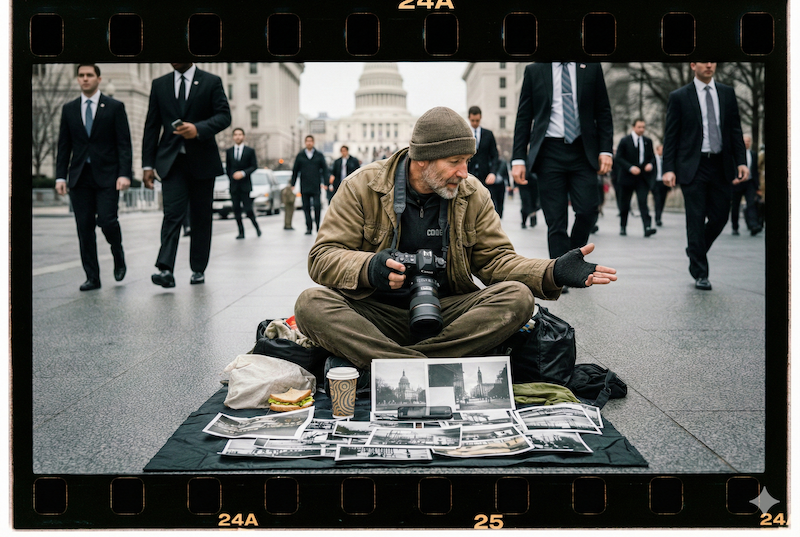

What people often forget about photojournalism is that it starts with the word at the end: journalism. And very often, they confuse photojournalism with news photography. They might seem the same, but they are not, far from it.
In photojournalism, everything starts with journalism. There is, first and foremost, a professional work to investigate that requires the consumption of resources (time and money, essentially) to understand and make sense of an event to its fullest, in order to report on it as extensively as possible. Journalism is the organized, accountable practice of observing reality on behalf of the public, selecting what matters, verifying it, and publishing it with responsibility for its consequences.
It takes specific attributes and skills, learned and refined over time: curiosity, deductive reasoning, education, ethics, empathy, understanding of one’s own biases, the humility to know one’s work will be questioned and must withstand scrutiny, and the ability to think quickly and efficiently. And above all, a passionate desire to inform others, coupled with the social intelligence to understand what others need to know to make decisions.
A photojournalist is all that, and happens to use a camera as a tool to write, instead of a pen or keyboard. The camera is a recording instrument. It captures light that traveled from the event to the lens, direct physical evidence of what was. This indexical relationship to reality is photography’s fundamental value. Because we understand our world primarily through visual input, a camera and its unique ability to capture information almost as it is becomes their preferred medium of exchange. It is much harder to twist light than words, and thus, it makes a tool less likely to carry bias.
And so, a photojournalist is a journalist first, who builds understanding and explanation via a light-based camera. A news photograph is something anyone captures with a camera because they happen to be there at that time. The two are not interchangeable. While they might both appear to communicate information, one does so with a full understanding of the context and all it implies, while the other is just a snapshot.
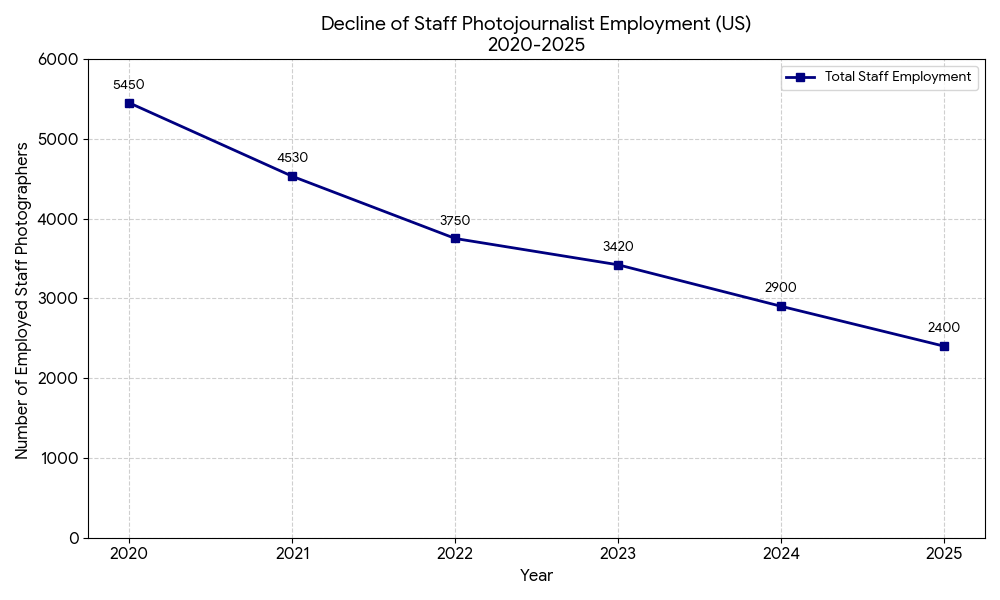
But here’s what’s crucial: A photojournalist also works in an environment thick with professional fact-checkers. They operate within a structure, a newswire, a newspaper, surrounded by editors and writing peers who process and verify what they transmit. Photo editors coordinate their work and scrutinize their narrative to verify accuracy. Captions are fact-checked. Often, photojournalists work in tandem with a reporter covering the same story, and together, they build a fully vetted, well-documented explanation of an event. That ecosystem refines the accuracy of the captured information and guards against personal bias and errors.
A news image is a picture taken by someone who is at a news event, professional or not, who does not have anyone to answer to, besides maybe their bank.
So when the entire photojournalism staff of a newspaper, along with their photo editors, gets laid off, it’s not just a few photographers who disappear. We lose the people who know how to read a scene, who understand what questions the image must answer, who can distinguish between what happened and what it looked like from one angle. It’s a whole ecosystem of intelligent news-gathering and dissemination that’s been shut down. And with it, our ability, everyone’s ability, to make sound decisions about their world.
And no, it cannot be replaced by news pictures, because those serve a different purpose. A news picture’s use is illustration, not comprehension. You see with a news picture; you do not understand. It’s the difference between a mirror and a map.
At precisely the moment when anyone can generate a photorealistic image of anything that never happened, we’re eliminating the people whose entire professional practice is built on being there, on witnessing, on accountability. We’re destroying the institutional structures that turn presence into credible testimony. Identifiable authors with pedigree, people whose names mean something because they’ve earned trust through verified work, should be protected, not discarded.
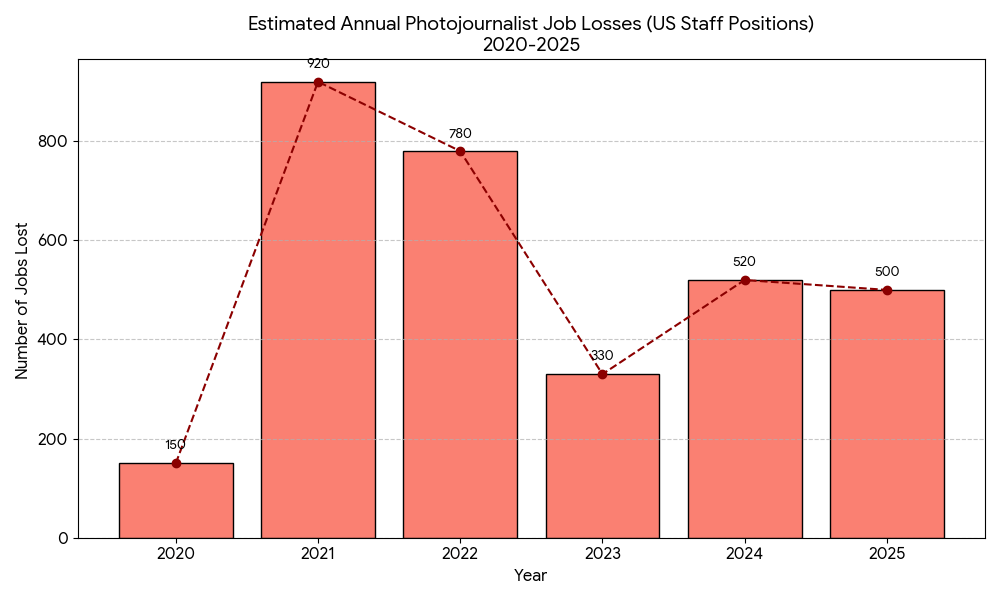
Provenance, along with all the professionalism it carries, is what will substantiate our ability to make sense of our world. If we destroy its source, and that is what we do when we eliminate photojournalists, we destroy our chance to have a society where individuals have an immutable reference to reality and truth. We let ourselves be guided by the currents of social media trends, splashing and wading in the endless, nauseous tides of TikTok, YouTube, and X, like orphans with no anchor to reality.
What the Washington Post has done isn’t cost-cutting. It’s the dismantling of the very mechanism by which our society verifies truth. When photography no longer captures the light, Democracy dies in darkness.
*References:
-
Bureau of Labor Statistics. (2025). Occupational Employment and Wage Statistics: Photographers (27-4021). U.S. Department of Labor. Retrieved from https://www.bls.gov/oes/current/oes274021.htm
-
Challenger, Gray & Christmas, Inc. (2026, February). The Challenger Report: 2025 Year-End Media Sector Layoffs and 2024 Comparisons. https://www.challengergray.com/blog/
-
National Press Photographers Association (NPPA). (2026, February 4). Statement on the Elimination of Staff Visual Journalism Positions at The Washington Post. https://nppa.org/news/
-
Press Gazette. (2026). Journalism Job Cuts Tracker: 2023–2026 Data Analysis. https://pressgazette.co.uk/news/journalism-job-cuts-in-2026-updates/


