
Public photo industry surveys are so rare and few that it is always a refreshing exercise to review one when they do come out. VisualSteam just released the 2015 edition of its Art Buyer Survey and it surfaces some interesting trends.
Leslie Hughes, VisualSteam’
Another important fact showcased by this study is that RF still dominates the photo licensing landscaped. Not the microstock type but rather the more traditional, higher price point version. While the study does not dig deeper into the reasons why, a cross-reference to other answers seems to point to a crucial need for quality imagery. While the RF licensing model is the easiest to manage for buyers, they still overwhelming seek the higher editing standards of the traditional RF. Rights-Managed and Microstock tied at 58% as the second most common license types with RM down from 66% a year ago and Micro down from 60% a year ago. The biggest surprise, in our eyes, is the sharp rise in free photos usage, up to 41% (was 33% a year ago).

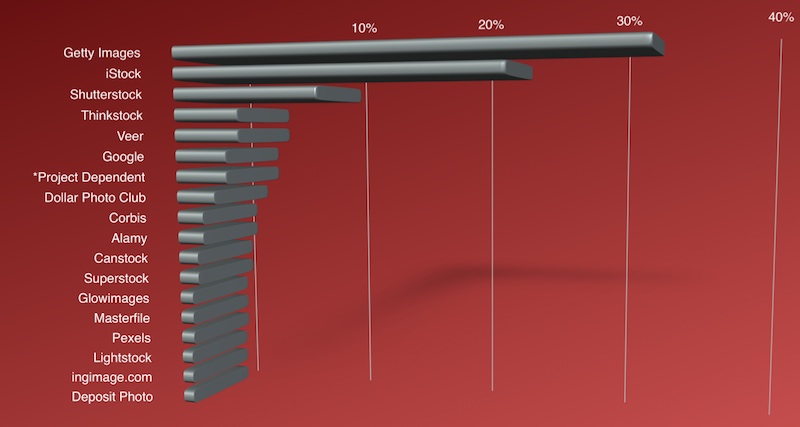
When asked what are their first stop go-to source for stock images, the panel overwhelmingly pointed to Getty Images, followed by Istock and then Shutterstock. This bias towards Getty is not due to the need for editorial images since the panel is in large majority commercial stock buyers from the ad/design/marketing / corporate world. Rather, professional image buyers seem to seek Getty’s offering due to its scope, its reinvention and just probably because of long-established habits. Shutterstock has only recently ( last 2 years) addressed the high volume image buyer segment and might not yet offer the full scope of its demand. Let’s not forget, as well, that Getty Images’ revenue is twice of Shutterstock’s.
Also interesting to note is the high position of Google in the result, confirming that the search engine is used as a meta search for visual content. As well, the Dollar Photo Club, a sub-brand of Fotolia ( acquired by Adobe and in the process of being shut down) rates higher than the larger, longer-established Corbis. Finally and also of importance, Pexels, a source of free images, marks the first ever appearance of a free site in the list, above a couple of microstock companies. One reason cited often is not pricing but originality/freshness of content. Interestingly, no mention of social media UGC content (Instagram, Pinterest, Flickr) appears on this list.
The VisualSteam study has many more points of interest and offers a comprehensive snapshot of buyers’ habits and motivations. It should be a required read for anyone in the stock photo business, especially in the USA. It is free for members of the DMLA and $50 for other and can be downloaded here. For those who wishes to know more, there will be a whole session on “The business of Free” at the upcoming DMLA conference, with 3 free content companies owners (similar to Pexels) explaining their business model. You can register for the conference here.


