You are currently browsing the archives for the msnbc.com category.
- alexa (6)
- Aurora (7)
- Canada (9)
- celebrity (102)
- CEPIC (29)
- Cnn (6)
- commercial stock (140)
- copyright (71)
- corbis (128)
- Corpocrates (4)
- Cosmos (3)
- digg (4)
- E Reader (10)
- editorial (308)
- filter (31)
- finance (114)
- flickr (84)
- focus (28)
- france (42)
- getty (223)
- Good Enough (1)
- google (55)
- gumgum (11)
- HOLGA (10)
- idee (15)
- IPTC (28)
- Jupiter (26)
- keyword (62)
- law (52)
- lens (37)
- lensbabies (8)
- license (174)
- magazine (170)
- Magnum (16)
- mediastorm (17)
- Microstock (156)
- Midstock (36)
- msnbc.com (14)
- multimedia (77)
- news (157)
- newspaper (72)
- Newsweek (16)
- No sense (56)
- PACA (26)
- Pacific coast news (6)
- photojournalism (217)
- Photoplus (3)
- photoshop (11)
- Piclens (3)
- pictogram (2)
- picturemaxx (2)
- Plus (8)
- prosumer (80)
- Royalty free (99)
- Search (89)
- SIPA (13)
- slideshow (67)
- Social Media (2)
- technology (202)
- TIME (32)
- transaction (130)
- Tweet (1)
- Uncategorized (26)
- Waste of time (1)
- web 2.0 (143)
- wire service (37)
- yahoo (14)
- Zymmetrical (6)
- September 3, 2010: Artist du Jour
- August 30, 2010: Of Photography and Trash cans
- August 24, 2010: I hear blue
- August 24, 2010: Buy a Book
- August 5, 2010: La vie en Rose
- August 4, 2010: Misc. Expenses
- July 29, 2010: Message in a Bottle
- July 26, 2010: Crowdtaste this !
- July 22, 2010: In search of Goodenough
- July 19, 2010: A genius talks
Blogroll
Important Destinations
Subscribe Here :
- September 2010
- August 2010
- July 2010
- June 2010
- May 2010
- April 2010
- March 2010
- February 2010
- January 2010
- December 2009
- November 2009
- October 2009
- September 2009
- August 2009
- July 2009
- June 2009
- May 2009
- April 2009
- March 2009
- February 2009
- January 2009
- December 2008
- November 2008
- October 2008
- September 2008
- August 2008
- July 2008
- June 2008
- May 2008
- April 2008
- March 2008
- February 2008
- January 2008
- December 2007
- November 2007
- October 2007
- September 2007
- August 2007
- July 2007
- June 2007
- May 2007
- April 2007
- March 2007
- February 2007
- January 2007
- December 2006
Archive for the msnbc.com Category
Cannot miss
October 14, 2009 by pmelcher.
If you have a few precious minute to throw away today , you HAVE to visit http://www.livinggalapagos.org/. A school project from the University of North Carolina, it is an amazing multimedia reminiscent of MediaStorm’s Kingsley’s Crossing by Olivier Jobard.
It is refreshing to see young photojournalist taking the current tools of reporting and putting all together in a refreshing perspective. This is the type of project we would like to see more often. This one deserves to be published on MSNBC.com and other established media outlets.
Posted in mediastorm, technology, multimedia, photojournalism, editorial, msnbc.com, news | Print | No Comments »
Size matters
February 2, 2009 by pmelcher.
While we see a proliferation of photography in our everyday lives, much more than we have historically have ever been subjected to, we also see it diminishing in size.
Before the 90’s and the advent of the web browser, our only interaction with still images was mostly in print magazines or huge billboards, along with catalogs, brochures and POP ( point of purchase) displays . Professionals would use a loupe to visualize slides in order to see its details. Some, like Life magazine, would use projectors against a big screen to select the images they would use.
It was a slow process, but however efficient. As our news pics, ads or family pictures migrated from print to digital, their size diminished suddenly. At first, it was web designer who, because of the limited bandwidth of our old phone modems (remember those ?), reduced every image to its bear minimum in order to make their site faster to load. The dictatorship of the thumbnail had arrived. Even later, when broadband arrived and became more popular, image size on the internet never really grew. This time, again under the orders of those web designers, it was in order to respect the average screen size of the majority of monitors.
Somehow, somewhat, these rules still remain. From Flickr to Facebook, from Cnn.com to Msnbc.com, without forgetting the banner ads that populate the borders of our favorite destination, the great majority of images that we see everyday have been reduced to thumbnail size . Not even the size of a 1/4 page in your favorite magazine or a 4 x6 print.
We live in a thumbnail society. The amusing part is most print publication have not really capitalize on this difference, and if anything, have reduced the number of double page spread. A huge mistake. Just look at the popularity of the Giga Pan of the Obama inauguration or the web site “The big picture“.
Photo agencies, worldwide, have put their catalog of images online and at a thumbnail resolution , whether it is editorial or commercial stock. lots and lots of small images.Millions actually. To the point that some smart photographers have realized that what they sell is not the image, but the thumbnail of the image. When they shoot and prepare images to be licensed on the commercial stock market, they make sure that the thumbnail is more than perfect. They even push their luck by making sure that it will appear as perfect square, as those will stand out better in the thumbnail space allotted to them. And it works. Most editors, confronted by database holding million plus images, quickly choose from the thumbnail first, going for a larger preview only to confirm their choice. They will handle the full resolution much further down in the process, mostly after they have already licensed the image.
And why shouldn’t they ? The image will probably end up on a website anyway, at a size similar or a bit larger than the thumbnail they actually picked initially.
News photographers do not have this choice, obviously. They continue to shoot with a full page magazine size in their head. Some still even think about the dying double page spread. None, or very little, have the thumbnail in mind.
Thinking about how your image will be seen as a huge influence on the way a photographer takes an image. No one would be crazy enough to use a large format camera for a website usage ( although I am sure some do anyways) as well as using a point & shoot for a glossy magazine cover.
The funny part is that, with no intended synchronicity, our equipment follows the same trend. All 35 mm photographers judge their work through a LCD panel no bigger than 3 inches wide. Sometimes, the same size as the final usage . The other ironic part, is that our televisions do not seem to stop its growth. Flat panel television seems to have liberate our sets of size constrain and more and more people are watching their favorite shows on displays the size of a wall. Strangely, at least in the US, the networks seem completely oblivious to this change and keep programming shows that do not take any advantage of this new size (Ah well, maybe in ten years..).
Ansel Adams and many others would have never become famous or succesful in this internet/thumbnail age . Have you ever seen one of his images in the size of a small square? Not impressive. We could go on for ever and ever with example of photographers that just can’t live in a thumbnail size
This is an Ansel Adams picture viewed as thumbnail
So what to do? Not much as of yet. As our TV sets merge with our computers, as our broadband continue to suck gigabits at speed light, our visual real estate/data capacity will continue to grow to a point where we will be able to enjoy National Geographic images the size of our walls with a resolution as close to reality as possible. Everything form Mediastorm’s great multimedia’s to a photo shoot with Angelina Jolie will finally blow up to a realistic size. Oh the possibilities…. However, this doesn’t bode well for the vertically framed image, but that is another story.
Posted in magazine, celebrity, Cnn, technology, commercial stock, mediastorm, multimedia, editorial, msnbc.com, photojournalism, flickr, news | Print | 1 Comment »
Social photojournalism
January 18, 2009 by pmelcher.
It’s web 2.0 for news. msnbc.con launched the first salvo today by publishing a “photosynth” of an Obama stop. Unlike traditional photosynth, it is an aggregation of images by one photographer and it sorts of defeats the purpose of the technology. A real one would have included thousands of images taken from different angles at different times. But the idea, and the effort is there.
Cnn.com, not to be outdone, is planning one for the inauguation. It is asking its users to send their images so they can be mashed up into a giant photosynth. Maybe they will pull out some images of Flickr. The result, should it be vastly followed, could be very interresting.
Albeit still in reasearch mode, this is the first time, in my knowledge, that a major news outlet will be using user generated content to create an exclusive rendition of a news event. It beats anything an agency can provide and will have some unexpected results. Furthermore, it will entice spectators to be actors in informing the world of a specific historical event.
It was we said all along, photojournalism is not dying, it is just evolving..
Update : MSNBC.com posted a photosynth made of wire service images and a couple of hired guns… Its the “non social” version of social journalism.
Posted in web 2.0, multimedia, magazine, technology, prosumer, flickr, slideshow, msnbc.com, photojournalism, editorial | Print | No Comments »
Alternative view
January 1, 2009 by pmelcher.
I like the new year. For one good reason. Everyone does a round up of all the best images of the year in a beautiful slideshow. So, like every year, I wandered through the internet, looking at different version of the year in pictures. This is where I went:
The Big Picture
The New York Times
And this is what I saw. Only pictures from either AP, Reuters, Getty and a little bit of EPA. All wire services, nothing else. At first I thought it was just a USA thing, but no. Even Der Spiegel, the famous German magazine did the same. Time magazine, The New York Times and Sports Illustrated decided that the best images were the ones that they had assigned, thus presenting only pictures of either staff photographers or assigned photographers.
Now, do not get me wrong. There are a lot of very talented photographers at the wire agencies, and some did an incredible job this year, but still. Ignoring photographers from Aurora, Redux, Noor, VII, Abaca, Sipa, Gamma, Reporters, Magnum, National Geographic, Minden, and so many other source, just because they are not accessible via a monthly payment is plainly ridiculous. Its pure journalistic laziness. And another pin in the machine.
All these so called photo editors who called themselves journalist either did not take the time to look around or simply refused to do so because it would cost them more money. Sad and pathetic. It is an insult to the photographic world to blindly close your eyes and the production of all these extremely talented photographers. It’s plain censorship. Economical censorship, maybe but still censorship. They will not publish and show these images because they are too expensive. Thus their readers will never see them. Not because they are bad, but because they will not pay for them.
Who is to blame ? The subscription model and the bean counters that have taken over. Who is suffering ? Everyone, since we are all deprived from seeing the real “best of” and only get to see a washed out version, pre packaged by the wires. What does it say about the state of our industry. Well, for one, that if you are not part of a wire service in 2009, you will have a hard time being published or seen. That real photo editors are disappearing and being replaced by researchers. That there is a real treasure to be mined for those who think outside the wires, and finally, that the public, the readers, are being scammed.
So all these year end “best pictures of 2008″ should be renamed “best cheap and affordable pictures of the year”, leaving room for someone with a budget, and a conscience, to do one with the real best picture of the years.
Posted in SIPA, magazine, Magnum, Aurora, TIME, photojournalism, editorial, finance, slideshow, msnbc.com, getty | Print | 1 Comment »
Photography and Petanque
November 5, 2008 by pmelcher.
I was working on the US presidential elections and something came to my attention that is worth mentioning here.
When everything was still slides and film, your cut-off time for stopping shooting was whenever the labs would accept the last bath or whenever the last flight was departing to where your agency was, or both. But it had nothing to do with the event itself, especially if lasted a long time ( think election night, for example. It should still be fresh in your mind). More or less, from a place like Chicago, all photographs would get to an editor’s desk the next day at the same time. Everyone had the same window for shooting, if they wanted to be the first on the light boxes of their favorite editors.
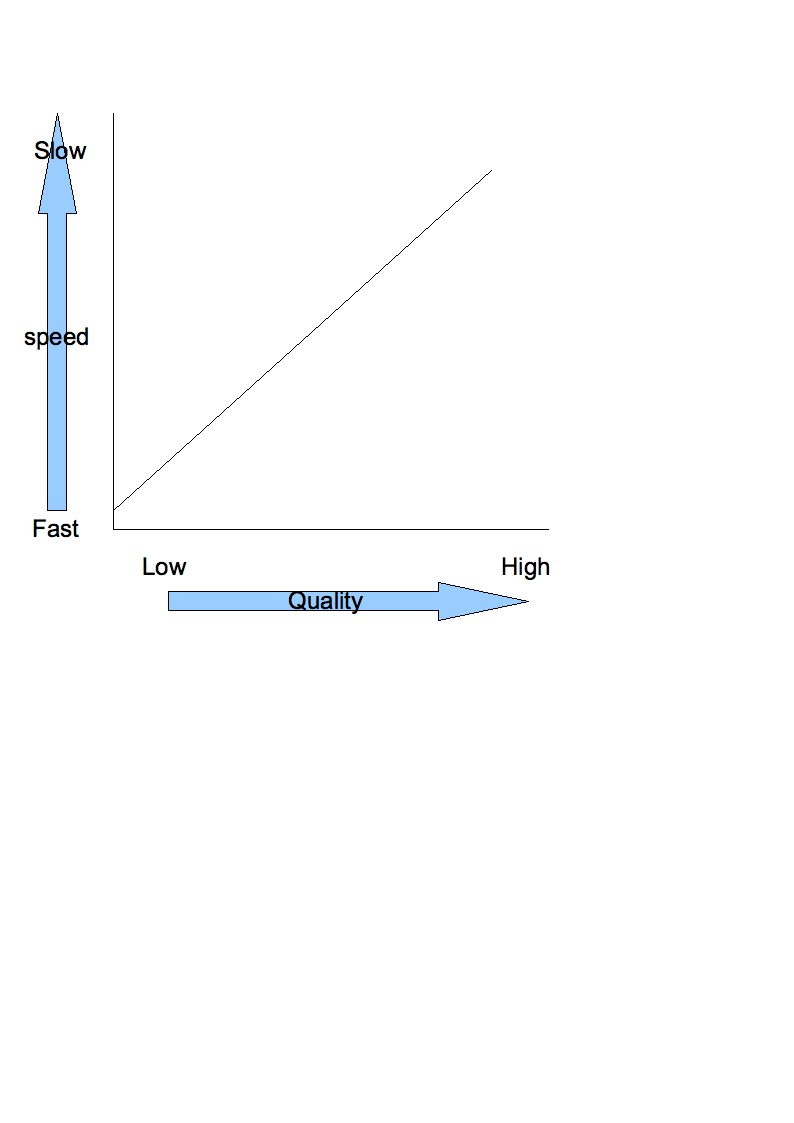
With digital, the speed of delivery has become an even more essential part of the selling process. So much so that even if you have a mediocre image that arrives just before a deadline, it will be published, as long as it is the only one around. As more and more images come in from different sources, the more the value of that image drops…and is replaced by better, late arriving images.
So, the later an image gets to a photo editor, the better it has to be in order to be chosen to be published. We then get a curve that looks like this:
A quickly delivered bad image has equal chance of being published as a long delayed great image. Thus a poor ( in talent) photographer can hold up to a greatly talented photographer as long as he transmits his images faster. At least, for a while.
Take the game of “Petanque” or “Boules“. The first one to throw his Boule will always be the closest to the Cochonnet or Jack, in English. A skilled player that comes after, will not only be able to push the Boule out of the way but also be the closest and eventually win. Just like news event photography.
With a slight twist, however :
In photography, it will not matter how great your images are if you miss the deadline of a publication. The winner, the published image, will, in theory, always be the best image that arrived before the deadline. Not the first one, but the best. In theory.
So, it so becomes, that what news photography is eager to capture, time, also becomes an instrument of its succesful propagation. Managed well, time can be a photographers best selling tool, regardless of his/her talents.
Posted in newspaper, magazine, technology, TIME, photojournalism, news, editorial, msnbc.com, getty | Print | No Comments »
“How can you kill something that people will do for free?”
June 19, 2008 by pmelcher.
When Brian Storm speaks, the world of photojournalism learns. The Poynter Institute, a journalistic school, has a 26 minute long interview with the founder of Mediastorm. The interview, being held in front of a boring backdrop by a girl who obviously needs some more courses in broadcast interviews could have used some visual pointers to go along Storm’s amazing insight.
Posted in multimedia, mediastorm, magazine, technology, newspaper, photojournalism, news, editorial, msnbc.com, corbis | Print | No Comments »
In between the lines
April 7, 2008 by pmelcher.
I will never understand the publishers stubbornness in designing magazine online. They literally replicate their print edition. Not just the content, but the layout. You have a cover/front page. You have sections, you have pages and along all that, a lot and lot of text .
Scrolling, for example, is much easier online. No need to change pages when all you have to do is scroll down. Why fix a limit on how far down you can scroll, when the majority of us have a wheel and can read down for ever?
One reason is that making you change page forces the page to reload, thus displaying new ads. Good for the publisher, not for the reader.
And what is it with this obscene amount of text? Since the launch of Netscape, back in the early 90’s, the web can easily display images, yet all publication use much more text than visuals. Yet the cost is practically the same.
One would have thought that, by now, all the news could have been delivered in a multimedia format. Instead of the linear print magazine format, the web offers video, sound, graphics and of course, photography, to give the readers a more three diminutional vision of a story.
Yet few, if none, use this ability. Its like driving a ferrari at 20 MPH all the time.
Magazine publishers, as we all know, are extremely resistant to change. If anything, they will do more of the same and copy their competition before they will innovate. They mostly believe that their content is so special, it cannot be brought down by the packaging. They should think again.
With the coming of age of the internet generation, those who grew up in the 90’s and are about to hit college, this will change fast. Right now they are busy absorbing. Absorbing Youtube, Facebook, EW online, myspace. They currently take what is being offered to them. As somewhat passive consumers. But when they hit the work force and take charge, they will certainly create a new medium and certainly affect it deeply.
Online magazine will be more web friendly, mixing text, video, voice over, photography to deliver the story. Navigation will no longer be up and down, left to right.
Interfaces will more like the one use by Brightqube who sadly currently only uses it for delivering RF images. You will be able to slide your way through a publication that will all reside on one page. Companies like MediaStorm will be able to produce more interactive multimedia, where one would be more involved in its unfolding instead of being a passive listener. For example, on a report on the Iraq war, one could decide between the short or long version, the unrated or family friendly version, wether to read or listen. And much, much more.
Magazine sites currently look like scanned magazines. TV sites, look like small tv sets. News site, depending on who produced it, look like their parent. Obviously they want to maintain their brand, and they will. But like microstock to the commercial stock world, they are leaving the door wide open for someone else to steal their readership.
And they will.
Posted in magazine, mediastorm, focus, technology, Piclens, multimedia, Search, msnbc.com, editorial, photojournalism, web 2.0, newspaper, news | Print | No Comments »
The Guardians
March 31, 2008 by pmelcher.
While photographers trade organization are wasting their time fighting issues like the Oprhan Work bill in order the save whatever they have left, and while photo agencies association seem violently silent, the world of editorial continue its downfall.
According to Radaronline, Newsweek magazine got rid of 111 staffers last week ( didn’t even know they had that many) and the newspapers of America had the worst ad revenue in its 50 years history, according to E&P.Worst than the 2001 slump. While analysts seem to confuse Getty going private with Getty shutting down, it is quite obvious that the tide is retreating before the big hit.
As previously written here, the editorial world will loose its dailies and weeklies in favor of the internet. It is not a question of if, but when. Monthlies will continue to thrive as long as they keep away from time sensitive news. The old ways will not continue.
While this continues, photographers and agencies will continue to bear the heaviest load as they will be asked to support the biggest part of theit cost saving initiative. A lot of companies will sink with the ships they will be trying to save. Those who will survive are those who are, today, turning to the new market. Companies, like Getty, that have understood that the future is on the Internet and create for themselves opportunities to be competitive.
Istockphoto, and other micro/midstock agencies are a good example of internet savvy photo agencies. Lean, mean, fast, cost effective companies that have learned to both cut their costs and leverage technology to its fullest. They can reach wide and far accross the world and up and down the client ladder. Others have jumped into new licensing models like Gumgum which allows them to operate like a microstock on but a RM model.
The issue will be the relenvency of content. Currently, the internet is replicating the print editorial world. Some are adding video or multimedia, but it is still very linear. But that will change too as “born in the internet” art directors will re -invent the web page and how we consume our news. Photographers will and agencies will have to reinvent their offering to match it.
Getty, by going private, will certainly take advantage of this new situation. They have already by acuiring Istockphoto. The celebrity photo agencies have also initiated the switch by producing videos and embrassing new licensing models. Others will probablly decide that book publishing, exhibits, grants are a better way to go and try to carve a controlled market. But, with schools already using Wikipedia and other National Geographic sites as references, how long will this market survive?
More technology based solutions are peeking out of the horizon that can help this industry make a succesful transition. It is, a little, heartbreaking to see how slowly they are being ignored by the guardians of the old temple who beleive that saving what they have is better than growing in new markets.
Posted in copyright, license, Midstock, celebrity, magazine, Newsweek, gumgum, Zymmetrical, multimedia, TIME, editorial, news, getty, transaction, CEPIC, photojournalism, msnbc.com, Microstock | Print | No Comments »
Time and again
December 19, 2007 by pmelcher.
It has been a rather busy year in the photography business world but let’s not forget photography itself. For all those naysayer claiming that photojournalism is dead, that photography will soon be replaced by video, and for all the others that enjoy great photography, here is the msnbc.com year in review slideshow:
As usual, very biased towards American centric news ( one day they will expand their field of vision) , it still contains my favorite image of the year : a couple stranded on a california highway after their trailer has been blowned off by extreme winds while the fires rage behind, taken by David McNew. Since I do not beleive in fair use and do not wish to pay Getty for a license, you will have to see it in the slideshow.
sit down, take your time and enjoy. Slide show here
Posted in copyright, magazine, multimedia, photojournalism, editorial, msnbc.com, news | Print | No Comments »
Companies to watch in 2008
December 3, 2007 by pmelcher.
Photo agencies ( distributors) :
Getty Images: The already succesful company is under the gun to prove to investors it can continue to deliver on its historical growth. With not much left to acquire that would trigger a 30 % growth, it is left to its own demise to add fuel to its own engine. Already on the path to explore other revenue streams, like music (micromusic anyone ?) and video, it is about to launch itself into the B2C Eldorado and try to reap benefits from this ever promised land. All eyes are watching the giant at its second attempt ( remember the Art.com fiasco?) to cash in on this unknown territory. Also on the near horizon, hopefully, an accelerated effort to be as strong on international market than it is in the USA. The last quarterly report showed that Getty does not even make 5% of its revenue in Germany which is, after all, one of the biggest market in photography. Does Getty have the right people in place to make this happen ?
Corbis: The overweight rich kid of the industry is trying to shed some fat. With one of the best content in world, will it be capable of showing, finally, a profit? Will it stop playing games with papa Gates’ money and enter adulthood? We heard the promises, now let see it happen.
stockthatdoesntsuck: Will high end stock photography survive? Their content is amazing, their intention pure. Will the market support them? 2008 will certainly let us know.
SplashNews: With one of the smartest management in this industry who has the keen ability to ignore risks, Splashnews goes for the jugular. They just concentrate their fire to those images that sell very well, and that is it. Combine with a true understanding of how to leverage technology, it is one of the most succesful photo agencies around. Let’s not be surprised if Getty or Corbis are knocking at their door.
Zymmetrical: Launched in 2006, this mid stock has everything to please creative professionals. With not only photography, but also fonts, video and graphic, it is the one sop shop for budget conscious creative professional. It also allows pros to compete with amateurs on the same platform without giving up on pricing. At the end, only the best image wins.
Tech Companies:
Idee Inc : Still the one to watch on the image tracking field and beyond. Extremely succesful and innovative, it is the kind of company that will keep on surprising the industry over and over. The Toronto base company has its ears to the ground and its eyes fixed on the horizon. We should see and hear a lot from them in 2008, and even sooner.
Mochilla, Britepic, Picsout and others: This will be the year of the user-generated revenue. Following in the footsteps of Corbis and soon Getty, other photo agencies will offer free ad supported images to 60 million bloggers worldwide. A few unknown remain: What will be the photographers cut ? Will people click on the ads ? Will it be a revenue generator or gobbler ? Will it prevent agencies to continue doing adequate business with professional website ? Finally, will it devaluate images overall by making them so easily available ? Hang on to your seats, photography is going for a wild spin.
Brightqube: Came out of the gate with a huge, and well deserved WOW effect. But, once passed the cool interface, it is just another royalty free platform. What’s next ? Knowing the team behind it, be ready to be wowed some more.
Picturemaxx and others: Portals where everyone dump their images into one central server is so 1990’s. The next generation of agency will be using virtual portals. Image database networked to each other will deliver the ultimate user experience to image buyers. One location to search any or all photo agencies worldwide is the ultimate image buying tool. For agencies, especially the small and medium, being part of a global offering makes more sense. Ultimately, it will change the way this industry works over the web. Sub agents and distributors, beware.
The Outsiders : Like istockphoto, Idee, Mochilla, the photo industry is being re invented by people outside of this industry. A lot of companies are currently in alpha mode and ready to revolutionized the way we do business. The success of Flickr has brought a lot of attention to our industry and brilliant minds are looking to cash in. New ways to license, to search, to retrieve. There is a lot of very interesting projects in the works. Some will stick, some will not. a few areas of development are:
- Image licensing : pay per view
- Search : Semantic search ( French company new phenix are already years ahead)
- Auto keywording : image recognition applied to tagging
- Auto editing : Data mining applied to cognitive results.
- Automated translation: Become local without any additional work. Years of development about to break open.
- Intelligent images : images will tell you where they have been, who has seen them, for how long.
and much,much more..
Media companies:
MediaStorm: The ones to follow. Set extremely high standards to how our images will be seen by our children. Offers a 3D emotional quality to still photography. Brilliantly succeeds in adding video, sound, text and stills into intensely rewarding experiences. Question is, will Mediastorm become a media company by itself or just license its content ?
Msnbc.Com : At the forefront of what can be done with still photography and the web, Msnbc.com keeps on re inventing itself, making it one of the most desirable destination for web surfers. They have never stood still, never took their success for granted. Furthermore, they pay a decent price for photography. We like that.
The New York Times : As respectful to photography on its web pages as they are on the print edition. The quality and placement of photography keeps on rising as they have realized how important it is. With newspaper like this, photojournalism will never die.
Yahoo/Flickr/Google: Will they or will they not? The whole industry is buzzing with the prospect of these mega players entering the photo licensing business and squashing everyone in their path. Flickr had announce earlier this year that 2007 will be the “licensing” year. It did not materialized. Will 2008 be the year where the flood gates open ?
( Partial) Conclusion: by no means exhaustive, this list is a good indication of the companies that will start or continue to amaze us in 2008 . Feel free to add. I know I will…
Posted in Search, google, web 2.0, multimedia, mediastorm, celebrity, Midstock, prosumer, flickr, getty, Royalty free, corbis, france, msnbc.com, editorial, Microstock | Print | No Comments »